
A pipe bursts at 2 a.m. Heavy rain fills your basement overnight. A sprinkler line fails on a Saturday at the office.
What you do in the next 24 hours determines how much you get from insurance, whether you can save your floors and cabinets, and how long it will take for things to get back to normal – a week or three months.
Here’s what water mitigation looks like, why it has to be done fast, especially in Chicago, and how much it’ll cost.
Key Takeaways
- Water mitigation stops water from spreading into walls, floors, cabinets, and subfloors before mold sets in, and in Chicago, it has to start within 4 hours because heavy rain can back up the combined sewer and turn a clean-water leak into a sewage loss fast.
- The mitigation process includes shutting off the source, extracting standing water, containing the wet zone with plastic sheeting, drying the structure with air movers and dehumidifiers, and monitoring moisture until the walls and floors are dry.
- ServiceMaster by Zaba provides water mitigation across Chicago 24/7 with IICRC-certified crews that arrive in under an hour and work with your insurance directly. Call (773) 647-1985.
Water Mitigation vs. Restoration: The Key Difference
| Mitigation What: Emergency stabilization after water damage |
| Restoration What: Rebuilding after water damage |
The 24-Hour Water Mitigation Timeline
Hour 0 — You call us. We pick up 24/7 and send our crew immediately. While they’re on their way, we’ll guide you on how to shut off the water.
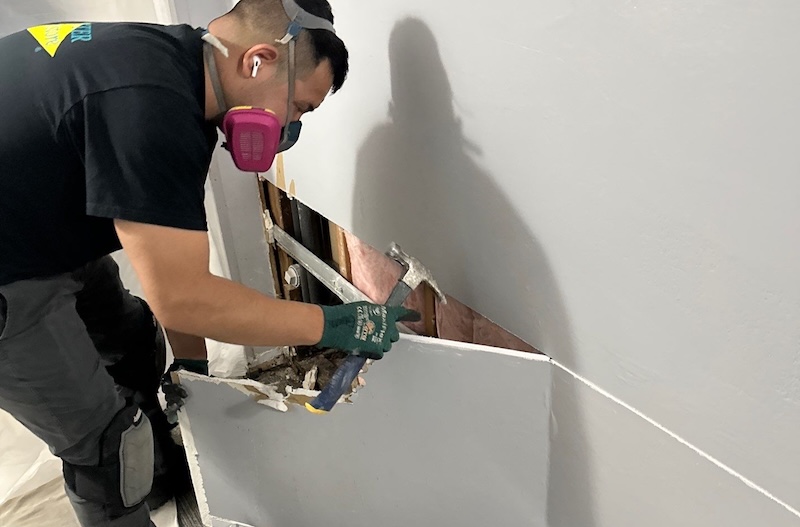
Hour 1– Assessment. Our crew’s average ETA is within an hour in Chicago. First, we scan the area with a moisture meter and thermal camera to find the source of water damage. Then, we determine how contaminated the water is (category 1,2, or 3) and how far it’s spread.
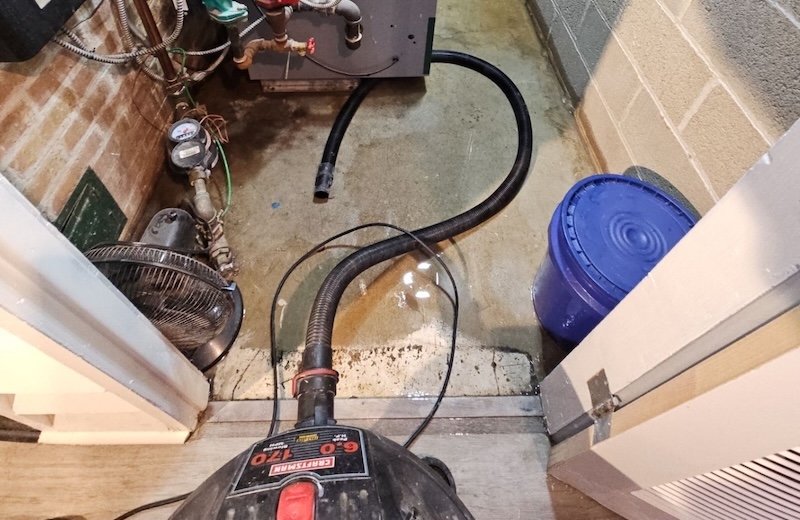
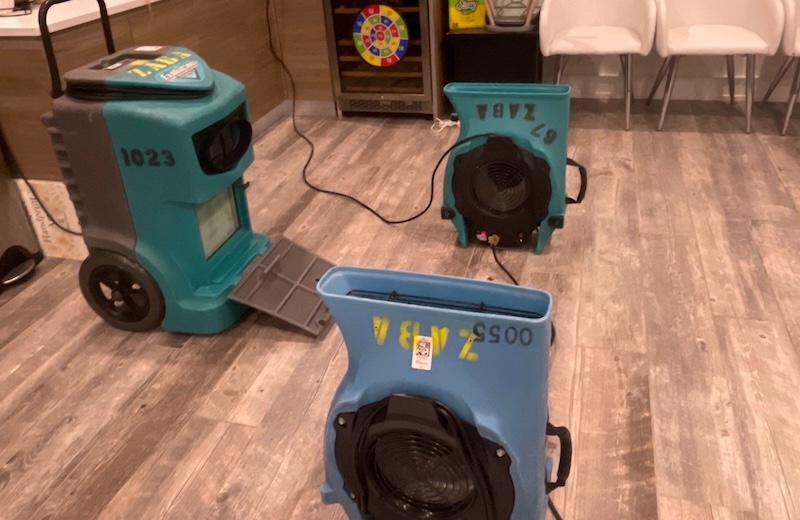
Hour 1–2 — Extraction. With truck-mounted and portable extractors, we pull standing water from carpet, flooring, and other porous surfaces. Hour 2–4 — Containment and drying setup. We isolate the wet zone with plastic sheeting and set up air movers, LGR dehumidifiers, and wall-cavity drying units.
By hour 4, water is no longer spreading. From this point onward, we’re focused on drying the area and monitoring moisture levels. (Timeline of completion is based on the size of the loss)
Hour 24 — Day-one assessment and moisture check. At this point, 30-35% of the moisture typically dries out. A tech takes additional moisture readings at every point that we logged in at the beginning, and if something isn’t drying fast enough, we put more focus on those points.
We send your insurance adjuster updated moisture readings and drying progress. This is also when we know whether materials will dry in place or need to come out.
Day 3–5 — Final drying. Dry standard for wood is typically below 15%. Once readings hit these levels, we take the equipment out.
The Three Categories of Water (and How They Affect Mitigation Costs)
What determines the cost of your water mitigation is the category of water.
- Category 1 — Clean water. Burst supply line, clean sink overflow, leaking water heater. This is the simplest to deal with, as it’s safe to work around and items dry in place.
- Category 2 — Gray water. Dishwasher or washing machine drain water, toilet overflow with no solids. It carries contaminants, so our crew wears PPE. We treat the area with an antimicrobial solution and take out the wet carpet padding.
- Category 3 — Black water. Sewage backups, toilet overflows with solids, river/lake flooding, or any rainwater contaminated by a combined sewer system. This situation requires full hazmat protocols. This means we can’t dry the wet drywall, carpet, and insulation. We must remove and replace them completely.
A Category 3 loss can cost you significantly more than a Category 1, and that’s because we’re demolishing the wet materials instead of drying.
Why Chicago Makes Fast Mitigation Non-Negotiable
In Chicago, waiting 48 hours to start mitigation isn’t fast enough. Three reasons:
- A combined sewer system can quickly flood your basement with sewage. Heavy rain can drop over 1.5 inches of water per hour during severe summer thunderstorms. Storm runoff and sewage share the same pipes and can back up through your floor drain. If you have a Cat-1 leak in your basement and the storm hits, that can easily turn into a Cat-3 issue.
- Old houses hold moisture differently. Pre-1930 bungalows, two-flats, and Greystones, which are common across Logan Square, Lakeview, Pilsen, and Bridgeport, have plaster-and-lath walls, fir subfloors, and cast-iron drain stacks. These materials can trap and hold moisture for much longer than modern drywall and plastic pipes do. A local restoration crew understands these unique challenges. Those without Chicago experience can misjudge how wet a wall actually is.
- Most Chicago basements are naturally damp. This environment keeps the mold spores active, so it can take hold within 24 hours. In a dry climate, mold would need 48-72 hours to grow.
The takeaway: mitigation in Chicago needs to start within four hours. For every hour you wait, the category of water can change, materials can absorb more moisture, and mold can start to form.
Should You DIY?
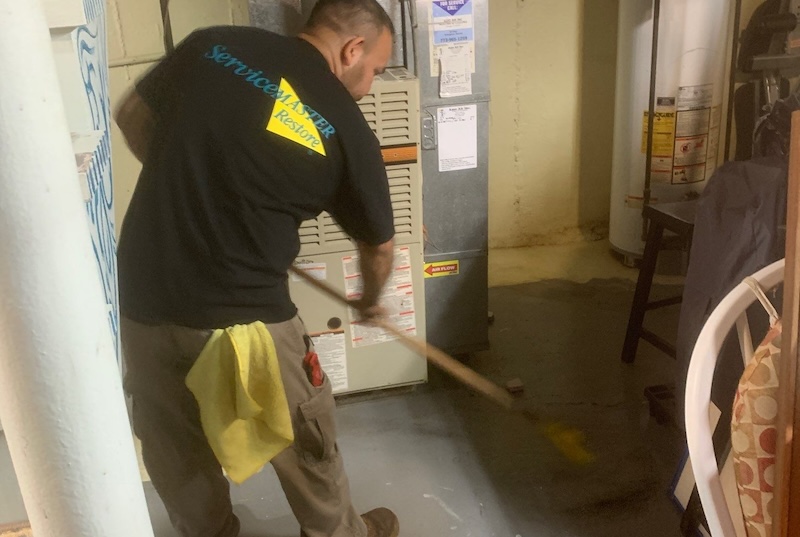
DIY may be okay if: the water is clean, affects the area under ~10 square feet, it hasn’t reached drywall or cabinetry, and you can fully dry it with fans within 4 hours.
Call a professional if: the water is anything other than clean, affects more than one room, water has reached cabinets or walls, it’s been sitting for more than 4 hours, you can smell sewage, you hear water inside a wall, or the loss happened during heavy rain. When in doubt — call us. We don’t charge to come out and assess the damage.
What It Costs and What Insurance Covers
Typical mitigation-only ranges in Chicagoland (reconstruction is separate):
| Scenario | Cost |
| Cat 1, single room, fast response | $1,800 – $3,500 |
| Cat 1, multi-room or basement | $3,500 – $8,000 |
| Cat 2, whole basement | $5,000 – $12,000 |
| Cat 3, basement with sewage | $8,000 – $25,000+ |
Here’s what insurance covers:
- Sudden internal water damage (burst pipe, appliance failure) — almost always
- Sewer backups — covers only if you add a sewer backup endorsement to your policy. In Chicago, this rider costs approximately $1500-$3000/year, and it’s something most homeowners skip. Check your policy now, before you need it.
- Surface flooding from outside — Standard homeowner insurance does NOT cover this. You need a separate NFIP or private flood insurance.
- Slow leaks you knew about — usually aren’t covered. If you knew about the leak and didn’t act on time, the duty to mitigate gives them grounds to deny part of your claim

We bill State Farm, Allstate, Liberty Mutual, Farmers, USAA, Travelers, Chubb, Erie and most major carriers directly. You pay your deductible, and we handle the rest.
Case Study: A Logan Square Job That Changed Category Before Our Crew Even Arrived
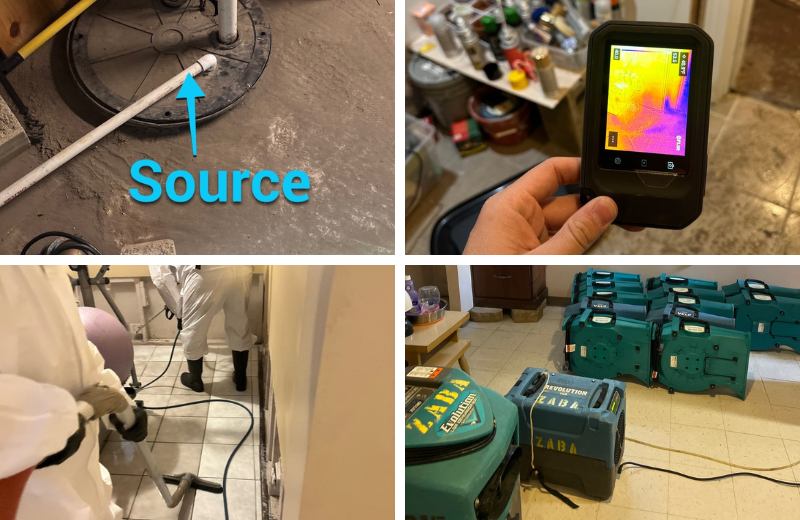
Here’s what happened last July during a storm. A two-flat owner from Logan Square called us. Their sump pump failed, and there was around three inches of water in the basement. On paper, this was a classic Cat-1 job.
Forty minutes later, we’re yet to arrive, and the rain picks up to 2 inches per hour. Chicago’s combined sewer overflowed. By the time our crew got there, sewage was coming up the drain. Now we’re looking at a Cat-3 loss.
This is no longer the same job. Now, our team must wear full protective gear, remove wet drywall up to 24 inches above the water, remove wet carpet and insulation, and apply an antimicrobial treatment to every porous surface. Finally, we must test the air quality before anyone can start rebuilding.
Original Cat-1 estimate of ~$4,500 turned out to be a Cat-3 mitigation cost of $14,800, just like that.
That’s over $10,000 difference just while we’re driving over. That’s why acting fast makes such a difference between drying and demolishing your basement in Chicago.
Need Water Mitigation in Chicago? We’re Here 24/7.
If you see standing water, water dripping where it shouldn’t, or the room smells like damp paper, you need to act. We respond, day and night, across Chicago and the suburbs. Plus, we bill most major insurance carriers directly.
Call (773) 647-1985 — we pick up every call, around the clock.
The faster you call, the smaller your bill will be.
FAQs
How quickly should water mitigation start?
Industry standard is 24–48 hours, but in Chicago, you should aim for under 4 hours. Combined sewer risk and old housing stock don’t give you the luxury of waiting.
Does insurance pay for mitigation?
In most cases, yes. There are some exceptions, though. You need a separate endorsement for sewer backups. Surface flooding requires floor insurance. Finally, if you knew about the leak and acted late, you’ll be denied.
How long does mitigation take?
For Cat-1 single room, 3–5 days. The whole basement takes 5–8 days. Cat-3 with sewage loss can run for 7–14 days.
What does mitigation include?
Stopping the source, removing standing water, drying it with professional equipment, antimicrobial treatment when needed, and full documentation for insurance purposes. It does not include rebuilding.
Can I DIY mitigation?
Yes, but only if the water is clean and hasn’t reached cabinets, walls, or flooring. Anything bigger, call a pro. Without proper equipment, you can spread moisture into walls that were dry before.
Can I stay in my home during mitigation?
That depends on the category of water. If there’s a Cat-1 loss in a single room, you can stay, but please note that the equipment is loud and runs around the clock. In the case of Cat-2 and Cat-3 losses, those involve airborne contaminants, so the space is unsafe to live in. We’ll let you know on the first visit if you need temporary housing.
Do I have to use the restoration company my insurance recommends?
No, the insurance may suggest their own vendor, but the choice is up to you. As long as the contractor is licensed and IICRC-certified, the insurance will pay for the work.


